Original Article
Awareness of Glaucoma in Different Groups of
Urban Population
Nasira Inayat, Muhammad Moin, Asif Manzoor
Pak J Ophthalmol
2014, Vol. 30 No. 3
. . . .
. . . . . . . . . . . . . . . . . . . . . . . . . . . . . . . . . . . . . . . .
. . . . . . . . . . . . . . . . .. . .. . . . . . . . . . . . . . . . . . . . .
. . . . . . . . . . . . . . . .
|
See
end of article for authors
affiliations …..……………………….. Correspondence
to: Nasira Inayat Department
of Ophthalmology, Lahore General Hospital, Lahore E-mail: nasira_dr@hotmail.com …..……………………….. |
Purpose: To evaluate the level
of glaucoma awareness among different groups of urban population Material and Methods: A
survey was conducted by Ophthalmology unit-II, Ameer-ud-Din Medical College / Post Graduate Medical Institute /
Lahore General Hospital, Lahore; Pakistan. Survey was conducted in three
different groups of civilians using non probability, purposive sampling.
Group I consisted of 150 Medical Students of first and second year in their
MBBS; Group II comprised of 115 student nurses; and Group III was composed of
150 adults from all public sectors. This study is an observational and cross
sectional study. Results: A total of 415 adults
answered the questionnaire made for awareness of glaucoma. In Group I, 13.3%
stated that they did not know what glaucoma meant. All in group II answered
as to what glaucoma meant; whereas, 48.7% in group III had not heard about
glaucoma. In Group I, 36% said that it was raised intra ocular pressure,
21.3% said it was an eye disease, 16.7% thought that it was another name for
blindness, 8% wisely answered it as an optic neuropathy, 2.3% translated the
word glaucoma in their local language (Urdu) as ‘kalamotia’,
1.3% students thought that it was a glucose related disorder, or a form of
diabetes and 0.7% thought that it was a name given to blindness due to
diabetes mellitus. In Group II, 80.9% nurses stated that the term ‘glaucoma’
meant a raised intraocular pressure, 15.7% thought that glaucoma meant
blindness, 2.6% stated that it was an optic neuropathy and 0.9% wrote that
glaucoma meant headache and vomiting. In Group III, 24% participants said
glaucoma meant loss of vision, 22% stated it was an eye disease, 4.7% knew
that it was due to raised intraocular pressure, and 0.7% said that glaucoma
meant watering from the eye. Conclusion: The
awareness of glaucoma is low in the general public. An efficient information,
education and communication strategy needs to be designed for early detection
and treatment of glaucoma to prevent blindness. Key words: Glaucoma, blindness, intraocular pressure. |
Glaucoma is the second leading
cause of blindness in the world1. The incidence of glaucoma ranges
between 6.5 to 7.5% indifferent parts of the world.2,3
With such a high incidence of a blinding disease, early detection of glaucoma
is essential to prevent blindness. Public awareness of this almost silent
disease plays a pivotal role in bringing the high risk patients to the
ophthalmologists, and hence, preventing the dreadful results. Spreading
knowledge about the disease not only helps to prevent blindness but also
reduces the economic burden of the disease4. Report of glaucoma
awareness surveys in different parts of the world have been used to identify
least knowledgeable subgroups in order to most effectively use the resources
for public education.5,6 No such survey has been previously
published from Pakistan before. Therefore we carried out survey to find out the
awareness level of glaucoma in medical students, nurses and general public in
Lahore. The most common source of information has been found to be doctors in a
study done in Ethiopia7. Three groups were used in the survey to
estimate the level of knowledge among group of people with different levels of
education.
MATERIAL AND METHODS
A
Survey was conducted by Ophthalmology unit-II Amee-rud-Din Medical College / Post Graduate Medical
Institute / Lahore General Hospital, Lahore; Pakistan. Survey was conducted in
three different groups of civilians using non probability, purposive sampling.
Group I consisted of 150 Medical Students of first and second year in their
MBBS; Group II comprised of 115 student nurses; and Group III was composed of
150 adults from all public sectors.
The
following were included in the study. Any one above age 18 years irrespective
of the gender was included. First group (Medical students): All medical
students of 1st and 2nd year from Ameer-ud-Din Medical College, having no clinical exposure to
patients. These students were attending their basic sciences lectures. Second
group (Nursing students): All student nurses from Nursing school, Lahore
General Hospital, Lahore; who also had some clinical exposure during ward
duties in addition to lectures on basic sciences. Third group (General public):
People belonging to any field of life whether educated or not but had never
received any medical education were included in this group.
The
following were excluded from the study. First
group (Medical students): All graduates, students of 3rd year and
above and anyone having clinical exposure (electives).Third group (General
public): Anyone who had any sort of diploma / degree in medical education.
Survey data was collected
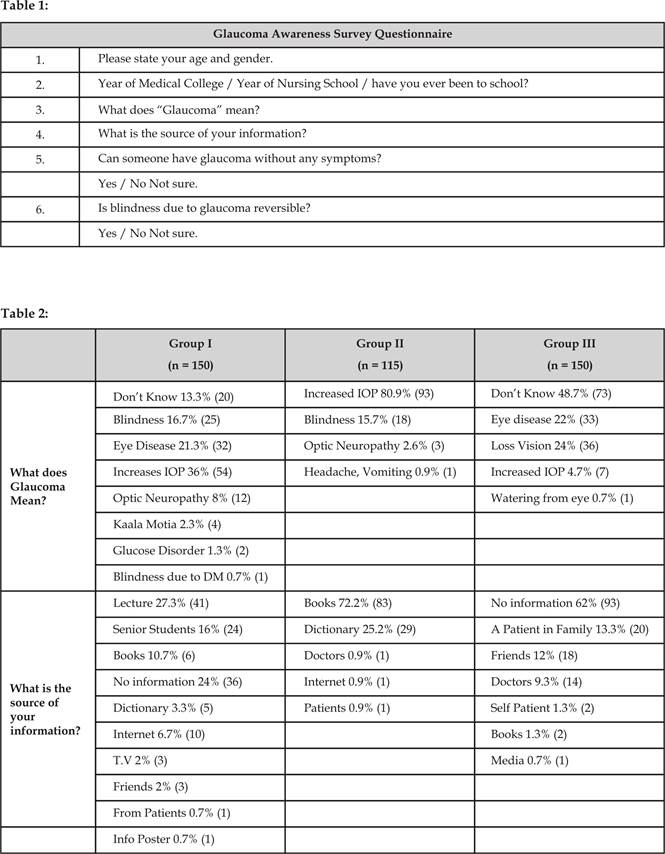
through a Performa having both open ended and close ended questions. All those
who fulfilled inclusion criteria filled survey form themselves anonymously
(except those who were uneducated or had language problem). Survey questions were
asked in simple language (table 1) and their answers recorded.
RESULTS
A total
of 415 adults answered the questionnaire made for awareness of glaucoma. Group
I, comprising of 150 medical students had a mean age of 19 years. Male students
were 40.9% and females were 59.3%. Group 11 had a mean age of 22 years and all
participants were females. In Group III, mean age was 39 years, where 63.3%
were male participants and 36.7% were females.
In
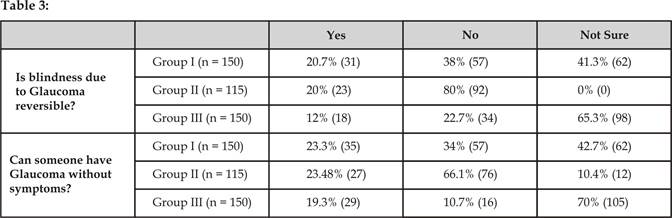
Group I, 13.3% stated that they did not know what glaucoma meant. All in group
II answered as to what glaucoma meant; whereas, 48.7% in group III had not
heard about glaucoma. In Group I, 36% said that it was raised intra ocular
pressure, 21.3% said it was an eye disease, 16.7% thought that it was another
name for blindness, 8% wisely answered it as an optic neuropathy, 2.3%
translated the word glaucoma in their local language (Urdu) as ‘kalamotia’, 1.3% students thought that it was a glucose
related disorder, or a form of diabetes and 0.7% thought that it was a name
given to blindness due to diabetes mellitus.
In
Group II, 80.9% nurses stated that the term ‘glaucoma’ meant a raised
intraocular pressure, 15.7% thought that glaucoma meant blindness, 2.6% stated
that it was an optic neuropathy and 0.9% wrote that glaucoma meant headache and
vomiting.
In
Group III, 24% participants said glaucoma meant loss of vision, 22% stated
it was an eye disease, 4.7% knew that it
was due to raised intraocular pressure, and 0.7% said that glaucoma meant
watering from the eye.
In
response to question about the source of information; in Group I, 27.3% had
gathered information from the basic sciences’ lectures in the college, 10.7%
read about glaucoma in different books, 6.7% gathered information from the
internet, 3.3% had read about it in a medical dictionary, 2% were informed
about glaucoma from the television and only 0.7% was informed by another
patient and 0.7% was a patient himself. 24% of the general public did not
answer the question in this group.
In
Group II, 72.2% of the nurses stated books as their source of information,
25.2% had known about it from the dictionary, 0.9% got information from the
doctors in the ward, 0.9% from the internet and 0.9% was a patient herself.
There
was no source of information about glaucoma in 62% of the general public
participants in Group III. 13.3% knew about the disease from involved family
members, 12% had friends suffering from glaucoma, 9.3% were told about glaucoma
by a doctor, 1.3% were patients themselves, 1.3% read about glaucoma in a book
and 0.3% were informed through media.
As an
answer to the question if someone could have glaucoma without symptoms; in
Group I, 23.3% said
yes, 34% said no and 44.7% were not sure. In group II, 23.48% said yes, 66.1%
said no, and 10.4% were not sure. In Group III, 19.3% said yes, 10.7% said no,
and 70% were not sure.
The
next question was if the blindness from glaucoma was reversible? In Group I,
20.7% of the medical students said that yes it was reversible, 38% said it was
not reversible and 41.3% were not sure. In Group II, 20% I of the nurses
thought blindness because of glaucoma was reversible and 80% wrote that it was
irreversible.
In
response to the risk factors associated with glaucoma, in Group I, 18.7%
thought family history was important, 36.7% thought old age and 44.7% were not
sure. In Group II, 19.1% thought family history as a risk factor, 51.3% old age
as a risk factor and 29.6%.
In response to the question
about what was the perceived risk of getting glaucoma in patients at risk; In
Group I, 32% thought that there was a high risk, 10% answered that there no
risk and 58% were not sure. In Group II, 94.8% stated that there was a high risk,
0.9% said there was no risk at all and 4.3% were not sure. In group III, 16%
said there was a high risk of getting glaucoma in the particular group, 0.7%
said there was no risk at all and 83% were not sure.
DISCUSSION
Although
different awareness studies have been carried out in the developing world to
find out the level and depth of knowledge about glaucoma in the general public,7,8 we decided to include the awareness level of
medical students and nurses for a comparison. In the study mention above7,
the most common source of information among the public were the ophthal-mologists attending to the glaucoma patients.
In our
study 4.7% of the general population of the city of Lahore knew about glaucoma
to the extent that it was a raised intraocular pressure that caused blind-ness.
This figure is almost double to what was found in the urban population of
Ethiopia 2.4%7, and in the urban population of India 2.3%8.
But our sample size is small. 150 civilians from all classes ranging from house
maids and domestic guards to house wives and high class office bearers, only
seven knew what glaucoma meant. There was no difference between the awareness
levels in both genders, which is similar to the studies done in the western
world.9-13,16
We
found that the awareness about glaucoma was depressingly low in the general
public but those who had heard about glaucoma also had a good knowledge about
it. This is in contrast to two studies of glaucoma carried out in Australia
where a reasonable portion of population had heard about glaucoma but only a
few had knowledge about it.10,13 In Chennai, India14, a
similar survey was carried out, where it was found that rate of awareness about
glaucoma in rural population was 13.3%. 0.5% had a good knowledge, 4% had a
fair knowledge and 4.2% only knew that glaucoma was an eye disease. This is
again a very dissimilar result as compared to our result.
Ophthalmologists
were found to be the most important source of information in our study,
whereas, friends were the main source of information in a German survey11,
and media was reported to be the most important in rural India14.
Information from the close acquaintances was apparently the only source in
Southwestern Ethiopia10. It was particularly observed that health
information about ophthal-mological diseases was
scanty on the media, while information campaigns on diseases like dengue fever
were very successfully carried out through media.
Educating
people about the glaucoma is mostly being carried out by the ophthalmologists
themselves, which is only limited to the patients attending the ophthalmology
clinics and tertiary hospitals. Nurses, medical students and media should be
used to spread the awareness about the disease. All those who are suffering
from the disease should be convinced to get their relatives screened for
glaucoma. Free screening services should be available to those coming for
screening, as it is carried out in the developed countries16.
Although our sample size is small,
but it has given us a rough idea that to improve awareness of the disease we
can effectively use nurses and medical students in helping the general
awareness of the disease. Media is another very important and completely
neglected source, that can play a vital role in bringing the suspects of
glaucoma to screening centers and hence an early diagnosis.
CONCLUSION
The awareness of glaucoma is
low in the general public. Our sample size is small but similar results can be
suspected in larger population group studies. It was satisfactory to find the
level of knowledge in the nurses, who can be effectively used for spreading
awareness. An efficient information, education and communication strategy needs
to be designed for early detection and treatment of glaucoma to prevent
blindness.
Author’s Affiliation
Dr. Nasira
Inayat
Senior Registrar in
Ophthalmology
Lahore
General Hospital, Lahore
Prof. Muhammad Moin
Department of Ophthalmology
Lahore
General Hospital, Lahore
Dr. Asif
Manzoor
Post Graduate Trainee,
Department of Ophthalmology,
Lahore General Hospital, Lahore
REFERENCES
1.
Resnilkoff S, Pascolini D, Etya’ale D. Global
data on visual impairment in year 2002. Bull World Health Org. 2004, 82: 844-51.
2.
D
Grosvenor, A Hennis: Incidence
of glaucoma. West Indian med J. 2011; 60:
3.
Mehar P, Shahzad A: Glaucoma burden in a public
sector hospital. Pak. J Ophthalmol. 2008; 24: 112-7.
4.
Noertjojo K, Mabertey D, Courtright P.
Awareness of eye diseases and risk factors: identifying needs for health
education and promotion in Canada. Can J Ophthalmol.
2006, 41: 617-23.
5.
Javitt JC.
Preventing blindness in Americans: the need for eye health education. Surv Ophthalmol. 1995; 40: 41-4.
6.
Deokule S, Shah
S. Chronic open angle glaucomaawareness of
the nature of the disease, topical medication, compliance and the prevalence of
systemic symptoms. Ophthalmol Physiol
Opt 2004; 24: 9-15.
7.
Tenkir A, Soloman B, Deribew A.
Glaucoma awareness among people attending ophthalmic outreach service in
Southwestern Ethiopia. BMC Ophthalmol. 2010; 10: 17.
8.
Dandona L, Dandona K, Jhon R, McCarty C, Rao G. Awareness of eye diseases in an urban
population in southern India. Bull World Health Org. 2001; 79: 96-102.
9.
Gasch AT,
Wang P, Pasquale LR. Determinants of glaucoma awareness in a general eye clinic. Ophthalmology.
2000, 107: 303-8.
10.
Attebo K,
Mitchell P, Cumming R, Smith W: Knowledge and beliefs about
common eye diseases.Aust N Z J Ophthalmol.
1997; 25: 283-7.
11.
Pfeiffer
N, Krieglstein GK, Stegan
W: Knowledge about glaucoma in the unselected population: a German
survey. J Glaucoma. 2002; 11: 458-63.
12.
Mansouri K, Orgul S, Gibbons F, Mermoud A: Awareness about glaucoma and
related eye health attitudes in Switzerland: A survey of general public.Ophthalmologica. 2006, 220: 101-8.
13.
Livingston
PM, et al: Knowledge of glaucoma and its relationship to self care
practices, in a population sample. Br J Ophthalmol,
1998; 82: 789-5.
14.
Ramesh
V, Pradeep G, Gonnie G, et
al. Determents of glaucoma awareness and knowledge in urban Chennai.
Indian J Ophthalmol. 2009; 57: 355-60.
15.
Krishnalah S, Koval V, Srinivas M, Shamanna B, Rao G, Ravi T:
Awareness of glaucoma in the rural population of Southern India. Indain J Ophthalmol. 2005; 53:
205-8.
16.
Eke T,
Reddy MA, Karwatowski WS:
Glaucoma awareness and screening updates in relatives of glaucoma. Eye 1999;
13: 647-9.